Thursday, March 31, 2011

A Darker Domain by Val McDermid

Here’s a useful new term: Tartan Noir. It describes a form of Scottish crime fiction characterized by troubled protagonists and plots that deal with questions of redemption. It turns out there’s also Scandinavian Noir (troubled protagonists and changing society; authors include Henning Mankell, Karin Fossum and Arnaldur Indridison), and Mediterranean Noir (troubled protagonists and governmental corruption; authors include Andrea Camilleri and Michael Dibdin). Most of the crime novels I’ve read in the last few years fall into one of these genres, it turns out, including A Darker Domain.

I liked this one a lot. It’s a standard police procedural with POVs from several different characters. I liked the two female protagonists (a cop and a journalist, both investigating the same crime). So many of these “noir-ish” books have a dearth of female characters. McDermid’s two female leads are not as tortured as some of their male counterparts (Kurt Wallander's depression, and Erlendur’s troubled family come to mind) but they still have their demons. McDermid’s writing is excellent and her plotting is complicated but accessible. I also liked the relative lack of blood and gore, though I hear some of her other titles feature more violence.

Hey, what about Stalin’s Ghost, by Martin Cruz Smith? Arkady Renko is certainly a detective with issues, and all those books dwell on corruption and moral ambiguity in both the old and the new Russia. But a quick Google search for “Russian Noir” yields only links to articles about Russian photographers, film makers, and Pinot Noir from California’s Russian River Valley; no one has yet used the term to refer to this type of fiction. Folks, you heard it here first!

(Book 9, 2011)

Friday, March 25, 2011

Her Fearful Symmetry by Audrey Niffenegger

I hate it when a character does something that is …out of character. Not just unpredictable, but something that you just feel like that character wouldn’t do. In this post from last week I talked about how “confabulated characters walk about in our heads with the authority of our own friends and relatives (Lionel Shriver, The Financial Times, Feb 26/27, 2011).” And when you know a character as well as you know your own sister (for example) and then she does something that you just know she would not do, it’s like a blast of cold air that interrupts and ultimately diminishes the whole reading experience. This was the experience I had with Her Fearful Symmetry.

Her Fearful Symmetry is the story of 20-something twins, Julia and Valentina, who inherit a flat in London from their late aunt Elspeth (who is the twin sister of their mother Edwina). Lots of baggage (literal and emotional) comes with the flat, including Elspeth’s lover Robert (who inhabits the flat downstairs) and Martin, the OCD-suffering neighbor from upstairs. Also Elspeth’s ghost, who is at first just a puff of air but eventually transforms herself into something quite a bit more powerful and possibly malevolent.

Julia and Valentina are shallow and self-absorbed. They spend a lot of time playing dress-up in Elspeth’s quirky outfits and wandering pointlessly around London. Robert is devastated by Elspeth’s death and Martin is crippled by his mental illness. No one is happy or even very functional. Despite my lukewarm feelings toward the characters, I found that the book contained enough intrigue and atmosphere to propel me along nicely, until I was yanked out of the story by a decision Valentina makes about ¾ of the way through. It ruined the whole rest of the book for me, and made everything that came afterwards seem forced and manipulative. I wish the author had chosen a different method for accomplishing her goals. Still, this is an interesting book about death and separation and all the ways in which people can be both together and apart, and maybe that plot twist won’t bother you as much as it bothered me.

The flat that Julia and Valentina inherit is in the London neighborhood of Highgate and backs up to Highgate cemetery. Many scenes take place in the cemetery: Elspeth is buried there, Robert works as a guide there, and is writing a history of it, and the twins walk there frequently. Highgate cemetery is a stunning example of the Victorians’ overblown sentimentality toward death and is filled with elaborate monuments to dead poets, and twisty paths through dense underbrush. It figures strongly in another book I liked a lot, Falling Angels, by Tracy Chevalier, and provides a satisfyingly creepy backdrop for a lot of the action in this book. A few years ago on a trip to London I dragged my friend Catherine with me to see Highgate cemetery, and I thought she might never forgive me – she found the Victorian excess deeply disturbing, but I loved it.

(Book 8, 2011)

Wednesday, March 16, 2011

They're Alive!

I came across this paragraph about fiction recently, thought it was just brilliant and had to share it. It was from a review in the Financial Times by Lionel Shriver of Siri Husvedt’s new novel The Summer Without Men. Here you go:

Fiction relies on a baffling alchemy. At some point in the narrative, and with the best of books from the very beginning, a story the author cheerfully, even formally, concedes is invented seems actually to have happened. Through the aegis of our eagerness to be fooled, confabulated characters walk about in our heads with the authority of our own friends and relatives. It’s a wonderful and mysterious process, one I don’t pretend to understand.

Shriver goes on to say that “sometimes it doesn’t work” but that isn’t what interests me. I just loved how she expressed the role that fictional characters can take on in our lives: “confabulated characters walk about in our heads with the authority of our own friends and relatives.” That is how I feel all the time about my favorite characters. It’s my favorite part of reading fiction.

Friday, March 11, 2011

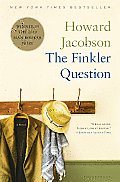
The Finkler Question by Howard Jacobson

The Finkler Question won the 2010 Man Booker Prize for fiction. Many people a lot smarter than I am have analyzed this book in depth, so I’m not going to do that. Any book about self-hating Jews and antisemitism is bound to generate a lot of discussion and I am certain that I have nothing new to add. A quick Google search will yield a zillion articles, both in the popular and the scholarly press, so if you want high level discussion, go there instead of here.

As I’ve said before, I am just interested in the reading experience, and for me, this reading experience was less than satisfying. Here are some good things about this book: The narrator is funny and has a strong original voice. He manages his characters with an ironic detachment, and provides amusing commentary on them, which I enjoyed. Here are some bad things: These unpleasant characters just go on and on and on and they never shut up. Hardly anything ever happens except for a few nasty incidents that get blown out of proportion by the self-absorbed people who experience them. I couldn’t stand those parts.

Apparently this book is a roman a clef, with several characters who are obvious parodies of well-known British academics and pundits. Since I am almost totally unfamiliar with the 21st century British intelligentsia, all those references passed me by completely. If you want, you could try to explore that angle, too, but I can’t be bothered. I’ve had enough of these folks.

(Book 7, 2010)

Tuesday, March 01, 2011

The Poisoner’s Handbook: Murder and the Birth of Forensic Medicine in Jazz Age New York by Deborah Blum

Having recently read The Immortal Life of Henrietta Lacks I was looking for more “science for laypeople” books. Deborah Blum won a Pulitzer Prize for science journalism and is a professor at the University of Wisconsin. One of her former students recommended this to me, and I’d also heard from several mystery readers that this was a really fun book, if you don’t mind a little chemistry with your drama.

Deborah Blum tells the true story of New York’s first chief medical examiner Charles Norris, and his right-hand man Alexander Gettler and their efforts to reform the way New York city officials investigated suspicious deaths and prosecuted suspected poisoners. Did you know that in the early part of the 20th century it was extremely easy to get your hands on a variety of nasty substances (my favorite is something called Rough on Rats which was 90% arsenic) and also really easy to get away with using said substances to murder someone? The U.S. Food and Drug Administration was in its infancy. Autopsies were primitive. Gettler and Norris saw the need for greater regulation and better analysis and they became crusaders for both.

This book is like a smorgasbord of information about poison and poisoners, and how Gettler and Norris went after both. It’s got detailed descriptions of how Gettler minced up flesh from human cadavers and subjected the resulting mush to a battery of tests as he tried to figure out the best way to extract the toxins. Norris focused more on policy – he hated Prohibition, for example, and assiduously tracked the sharp rise in deaths caused by the methyl alcohol in bootleg liquor. I also liked Blum’s vignettes about notorious poisoners such as Fanny Creighton, who managed to knock off several annoying family members with arsenic before she was finally caught and prosecuted. Blum’s prose is lively and she provides just the right mix of science and suspense to make this a great read.

(Book 6, 2011)